One VSME report, every questionnaire.
The VSME standard — the Voluntary Sustainability Reporting Standard for SMEs, developed by EFRAG and annexed to Commission Recommendation (EU) 2025/1710 of 30 July 2025 — gives smaller companies one recognised format for the ESG data their banks and large customers keep requesting. This hub explains what a VSME report contains, how VSME compares with CSRD after the Omnibus, and how Habitat prepares yours.
What the VSME standard is.
Three facts place VSME on the post-Omnibus map.
VSME was developed by EFRAG and annexed to Commission Recommendation (EU) 2025/1710 of 30 July 2025. It is non-binding, written for non-listed SMEs and micro-undertakings — companies that were never meant to carry a CSRD-sized reporting burden.
The Recommendation asks large companies and banks to limit the sustainability data they demand from SME suppliers to what VSME covers. That is the point of the standard: one report, prepared once, should be enough for every reasonable counterparty.
Omnibus I (Directive (EU) 2026/470, in force 18 March 2026) removed listed SMEs from mandatory CSRD scope and lifted the thresholds to more than 1,000 employees and EUR 450 million net turnover. For everyone below that line, VSME is the format the market is converging on.
Not sure which side of the line you sit on? Whether CSRD still applies to your company is a 60-second check against the post-Omnibus thresholds — we keep the test current at does CSRD still apply.
What goes into a VSME report.
The standard is modular. A Basic Module carries the disclosures most counterparties actually need; a Comprehensive Module adds the detail that larger buyers and lenders tend to ask of more exposed suppliers. You choose the module your counterparties' questions require — most first-time reporters start with the Basic Module and step up only when a specific request demands it.
In substance, a VSME report describes the company and its practices, its environmental footprint — energy use and greenhouse-gas emissions above all — and its workforce and business-conduct basics. The emissions section follows the GHG Protocol Corporate Standard: scope 1 covers direct emissions from fuels, company vehicles and processes; scope 2 covers purchased electricity, heat and cooling. We calculate with country-specific emission factors — including for markets such as Kosovo, Serbia and Bosnia & Herzegovina, where generic regional averages misstate the grid.
Who reads it? Banks, first of all: lenders have folded ESG questions into credit files, and a VSME-aligned dataset answers them in one pass — if a lender is your trigger, start at the bank ESG questionnaire page. Then large customers, whose CSRD duties push data requests down the supply chain. The same dataset also feeds ratings such as EcoVadis, where buyers check suppliers' scorecards during procurement.
VSME is deliberately the light end of a spectrum. If your company is growing toward the CSRD thresholds, or a buyer asks for more than VSME covers, the report becomes the foundation of a broader ESG consulting engagement rather than wasted work — the data model is the same, only the depth changes.
VSME vs CSRD, side by side.
| Question | VSME | CSRD after Omnibus I |
|---|---|---|
| Legal status | Voluntary — Commission Recommendation (EU) 2025/1710 | Mandatory for in-scope companies — as amended by Directive (EU) 2026/470, in force 18 March 2026 |
| Who it is for | Non-listed SMEs and micro-undertakings | Companies with more than 1,000 employees and more than EUR 450 million net turnover — both tests cumulative |
| Listed SMEs | The natural fallback format | Removed from mandatory scope by Omnibus I |
| Reporting standard | The VSME standard, one self-contained document | Revised (simplified) ESRS — mandatory from financial years beginning 1 January 2027 |
| Next reports | Whenever a bank or buyer asks — no fixed deadline | Wave-2 companies meeting the new thresholds report first in 2028, on FY2027 |
| Value chain | Defines the cap on what larger firms should ask SMEs for | In-scope companies gather value-chain data — which is why their suppliers receive questionnaires |
Sources: Commission Recommendation (EU) 2025/1710; Directive (EU) 2026/470; Directive (EU) 2025/794 (stop-the-clock). Status as of 31 October 2026.
How to prepare a VSME report.
A VSME reporting tool, with consultants behind it.
Most VSME software hands you an empty form and wishes you luck. Habitat pairs the tool with the people: consultants who know what your bank's questionnaire is really asking, and Karbon360°, our ClimateTech platform, keeping the data structured behind the report.
You enter energy and activity data once. The platform turns it into a greenhouse-gas inventory that this year's VSME report and next year's update both draw from — so when the counterparty changes, a different bank or a bigger buyer, the dataset stays the same and only the cover letter changes.
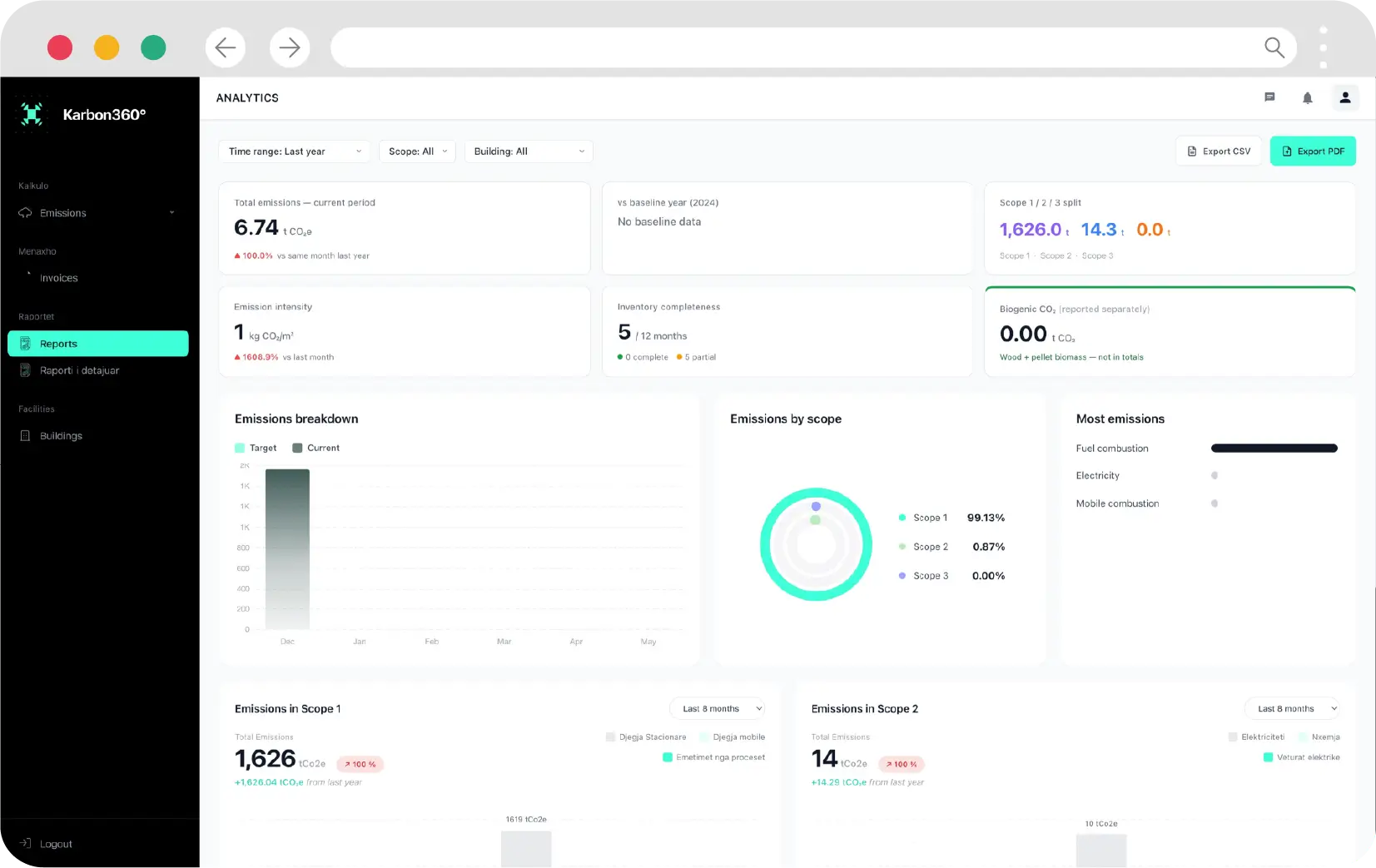
Karbon360°
Karbon360° transforms energy and business activity data into structured greenhouse-gas inventories — the numbers behind the environmental section of your VSME report.
VSME reporting services, end to end.
One engagement, from the first questionnaire in your inbox to a finished, reusable report.
Every engagement starts with whatever request triggered it. Send it over and you will have scope, timeline and price in writing — a fixed-fee quote within 48 hours.
The VSME standard, answered.
What is the VSME standard?
What is the difference between VSME and CSRD?
Is VSME mandatory?
Is there a VSME template?
Can I see a VSME report example?
A large customer sent us a supplier ESG questionnaire — is VSME the right way to answer?
Stop answering ESG questionnaires one by one.
Tell us who is asking — bank, buyer or rating platform — and Habitat prepares a VSME report that answers them all. Scope, timeline and price in writing within 48 hours.