Scope 1, 2 and 3 emissions, explained.
Under the GHG Protocol Corporate Accounting and Reporting Standard, Scope 1 is direct emissions from sources your company owns or controls, Scope 2 is indirect emissions from purchased electricity, steam, heat and cooling, and Scope 3 is every other indirect emission in your value chain — organised into 15 categories. This page puts the three scopes, the 15 categories and the method choices behind a corporate carbon footprint in one place.
One footprint, three scopes.
The GHG Protocol splits a company's greenhouse gas emissions by where they physically happen and who controls the source. Same company, three lenses.
Emissions from sources you own or control: fuel burned in boilers, furnaces and generators, the company vehicle fleet, process emissions from production, and fugitive releases such as refrigerant leaks.
Indirect emissions from the electricity, steam, heat and cooling you buy. They occur at someone else's plant, but they exist because of your consumption — and the GHG Protocol has you report them two ways.
Everything else, upstream and downstream: what you purchase, how goods move, how employees travel, what happens when customers use and dispose of your products. Fifteen defined categories, listed below.
A complete inventory covers all three scopes for one organisation over one reporting year. The scopes exist so that two companies trading with each other can each count their own emissions without inventing new ones — your Scope 1 is someone else's Scope 3.
What is carbon accounting?
Carbon accounting — greenhouse gas accounting — is the discipline of measuring an organisation's emissions in carbon-dioxide equivalents and reporting them under a recognised methodology. In corporate practice that methodology is the GHG Protocol Corporate Accounting and Reporting Standard, developed by WRI and WBCSD: it defines the three scopes, the organisational boundary options and the reporting principles that almost every questionnaire, standard and regulation builds on.
The mechanics are consistent whatever your sector: collect activity data (fuel consumed, electricity purchased, kilometres travelled, goods bought), multiply each activity by an emission factor appropriate to it, and consolidate the results by scope. The factor is where rigour lives — grid electricity in one country does not carry the emissions of its neighbour's grid, which is why factors must be country-specific rather than regional averages.
Carbon accounting stopped being voluntary branding some time ago. In the EU's current rulebook it feeds CSRD reports for the largest companies, VSME disclosures for SMEs answering banks and buyers, and the data requests that CBAM-covered exporters now receive from EU customers — the full picture is in our map of EU ESG rules in 2026. Different documents, same underlying inventory. The full definition, with the standards and the five steps of an inventory: what is carbon accounting?
The 15 Scope 3 categories.
| # | Category | Typical examples |
|---|---|---|
| 1 | Purchased goods and services | Raw materials, components, packaging, bought-in services |
| 2 | Capital goods | Machinery, buildings, IT equipment and vehicles you acquire |
| 3 | Fuel- and energy-related activities (not in Scopes 1–2) | Extraction, refining and transmission losses behind the energy you use |
| 4 | Upstream transportation and distribution | Inbound logistics and transport services you pay for |
| 5 | Waste generated in operations | Landfill, treatment and recycling of your operational waste |
| 6 | Business travel | Flights, trains, hotels, rental cars |
| 7 | Employee commuting | Staff journeys between home and work |
| 8 | Upstream leased assets | Assets you lease in that sit outside your Scope 1 and 2 boundary |
| 9 | Downstream transportation and distribution | Delivery of sold products paid for by others |
| 10 | Processing of sold products | Further processing of your intermediate products by customers |
| 11 | Use of sold products | Energy your products consume over their lifetime in use |
| 12 | End-of-life treatment of sold products | Disposal and recycling of what you sold |
| 13 | Downstream leased assets | Assets you own and lease out to others |
| 14 | Franchises | Operations of franchisees running your brand |
| 15 | Investments | Financed emissions in equity, debt and project portfolios |
Categories 1–8 are upstream, 9–15 downstream, per the GHG Protocol Corporate Value Chain (Scope 3) Standard. Not every category is relevant to every company — a screening decides which ones you quantify and which you justify excluding.
Each category in detail, with the data it needs and which ones usually dominate: the 15 Scope 3 categories explained.
Two choices decide your numbers.
First choice: the organisational boundary. Before counting anything, the GHG Protocol Corporate Standard has you decide how to consolidate: by equity share, by financial control or by operational control. Under operational control you account for emissions from the operations you run day to day; under financial control, for those you direct financially; under equity share, in proportion to ownership. The choice moves emissions between scopes — a leased factory can be your Scope 1 under one approach and your Scope 3 (upstream leased assets, category 8) under another — so it is made once, documented, and applied consistently.
Second choice: how to report Scope 2. The GHG Protocol Scope 2 Guidance requires dual reporting: a location-based figure, using grid-average emission factors for the grids where your consumption physically occurs, and a market-based figure, built from contractual instruments — supplier-specific rates, guarantees of origin, power purchase agreements — with residual-mix factors where no instrument applies. The two numbers answer different questions: what the grid emitted on your behalf, and what you chose to buy.
Both choices belong on page one of your methodology note, next to the emission factor sources — country-specific, named and dated. An inventory that cannot show its boundary, its Scope 2 method and its factors will not survive the first serious reviewer, whether that is a bank, a customer's ESG team or an auditor.
Buyers no longer ask whether you have a carbon footprint — they ask which scopes it covers and which factors it stands on.
Measured once, used everywhere.
The same Scope 1–3 inventory answers your bank's ESG questionnaire, fills the environmental metrics of a VSME report, anchors CSRD preparation and backs the emissions conversations EU customers now start with their suppliers. Companies that treat each request as a separate project pay for the same work several times over.
Habitat builds inventories on the GHG Protocol with country-specific emission factors across the Western Balkans and the EU, and runs the data side on Karbon360° — so the footprint stays alive after the report is delivered, instead of expiring in a spreadsheet.
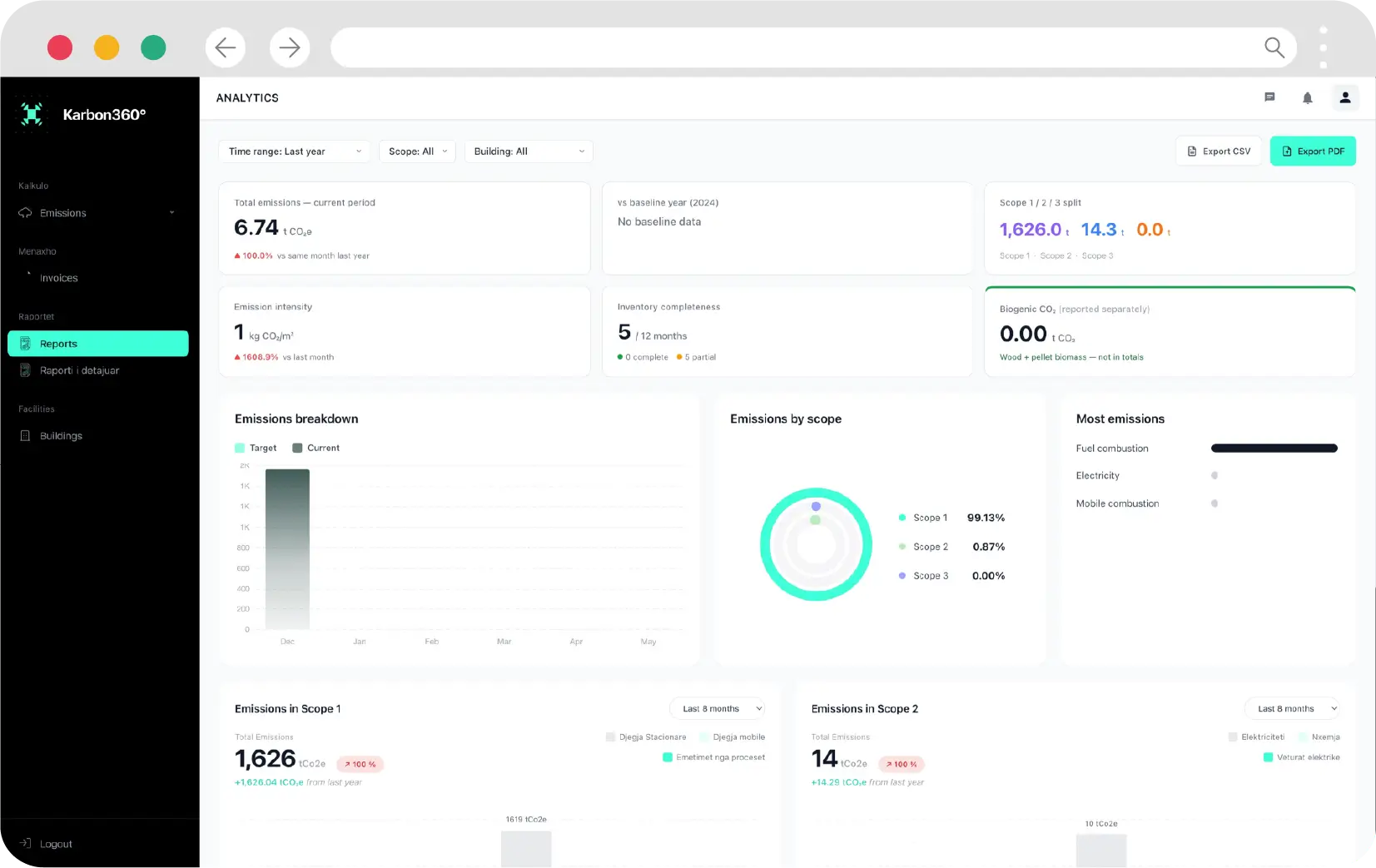
Karbon360°
Karbon360° transforms energy and business activity data into structured greenhouse-gas inventories — Scope 1, 2 and 3 in one platform, with country-specific emission factors and exports shaped for the reports and questionnaires that ask for them.
Frequently asked.
How do you calculate a corporate carbon footprint?
What is the difference between operational control and financial control in the GHG Protocol?
GHG Protocol vs ISO 14064 — which one do we need?
Which emission factor database should we use?
What is the difference between carbon credits and carbon offsets?
What is the difference between a corporate carbon footprint and a product carbon footprint?
Know your three scopes before someone asks.
Habitat builds GHG Protocol inventories for companies across the Western Balkans and the EU — boundary, factors and methodology documented, with a fixed-fee quote within 48 hours.