How to calculate embedded emissions for CBAM goods.
Every tonne of cement, iron and steel, aluminium, fertilisers, electricity or hydrogen imported into the EU carries a declared emissions number — and under Regulation (EU) 2023/956 your EU customer, the authorised CBAM declarant, cannot file without it. This is how to calculate embedded emissions for CBAM goods, translated from the official guidance into plain steps. For the importer side of the obligation, see our CBAM compliance services.
What embedded emissions actually are.
Embedded emissions are the greenhouse gases released in making a CBAM good, counted at the installation where it was produced. They are expressed per tonne of product, cover the direct emissions of the production process and — depending on the product group — the electricity consumed in making it, and they follow the good to the EU border, where they determine how many CBAM certificates your customer must surrender.
Two things they are not. They are not your corporate carbon footprint: a GHG Protocol inventory counts scope 1, 2 and 3 emissions for the whole organisation, while CBAM wants installation-level figures attributed to specific goods. And they are not only your own emissions: where you buy precursors that are themselves CBAM goods, their embedded emissions travel into your product with them.
The official methodology lives in dense guidance documents and an Excel workbook. The logic underneath fits on one page. It is four steps.
Four steps from records to a number.
Actual data or default values?
| Route | How it works | What it costs |
|---|---|---|
| Actual emissions, verified | You monitor the installation, calculate embedded emissions per good and have the data verified by an accredited verifier | No mark-up — the declared number is the real number |
| Commission default values | Your customer declares the per-good, per-country default values set by Implementing Regulation (EU) 2025/2621 | A mark-up of 10% on 2026 imports, 20% in 2027 and 30% from 2028 |
Default values and mark-up schedule: Commission Implementing Regulation (EU) 2025/2621. The committee-approved schedule holds 30% through 2034, with a methodology review targeted for completion by December 2027.
The mark-up is the commercial lever. A supplier whose verified numbers come in below the marked-up default makes its goods cheaper to import than a rival who leaves the declarant on defaults — the same product, a different CBAM bill. That difference lands in price negotiations long before it lands in any declaration.
The communication template, in plain terms.
The CBAM communication template for installations is a free Excel workbook published by the European Commission, with guidance available on its customs and taxation learning portal since May 2024. It walks an operator through the calculation above — boundary, activity data, attribution — and formats the result so an EU importer can use it directly. You do not need to build your own spreadsheet, and you should not: your customers will ask for data in this structure.
Since the definitive regime began on 1 January 2026 there is also a second channel: the operator module of the CBAM Registry, built exclusively for non-EU installation operators to register and share installation and emissions data with the declarants who import their goods. Registering once beats emailing workbooks to every customer separately.
Iron, steel and aluminium are where the calculation gets fiddly. Annex I of Regulation (EU) 2023/956 covers not only the basic metals but certain precursors and a set of downstream products such as screws and bolts — so one producer may have supplier data coming in and customer requests going out at the same time. The earlier you map which of your inputs are CBAM goods, the fewer late surprises in the workbook.
From one-off answer to standing capability.
The first data request is rarely the last. Every import year repeats the cycle — collect, calculate, verify, hand over — and each of your EU customers needs the same figures in the same structure. Treated as an annual scramble, it burns weeks; treated as a data pipeline, it becomes routine.
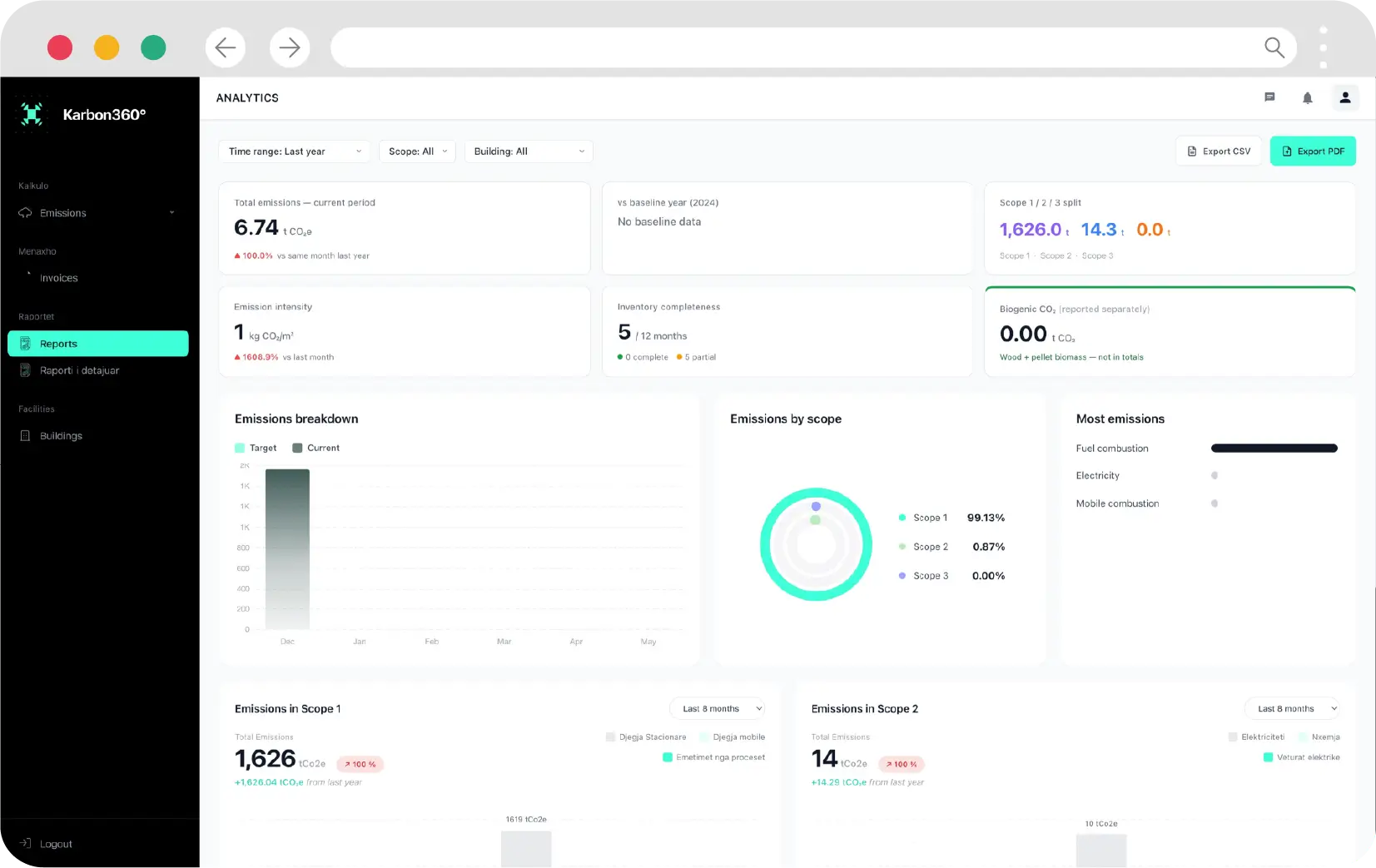
Habitat sets up the boundary, the data collection and the template, and Karbon360° keeps the numbers current between requests — so when a declarant, a verifier or a new customer asks, the answer already exists.
Karbon360°
Karbon360° transforms energy and production data into structured greenhouse-gas figures — installation-level numbers your EU customers can declare, with the audit trail a verifier expects.
Frequently asked.
How do you calculate embedded emissions for CBAM?
What is the CBAM communication template for installations?
How are embedded emissions calculated for steel and aluminium?
Can our EU customer just use default values instead of our data?
Do we have a legal obligation under CBAM as a non-EU producer?
Does embedded-emissions data have to be verified?
Get a number your customers can declare.
Habitat runs embedded-emissions calculations end to end for producers and importers — boundary, data collection, the communication template and verification support — with scope, timeline and price in writing.