Your EU customer asked for CBAM emissions data.
If an EU buyer has asked you for CBAM emissions data, the request is regulation-driven: under Regulation (EU) 2023/956 your customer must declare the embedded emissions of every CBAM good they import, and the actual values behind them can only come from your installation. This is CBAM for exporters in practice — exactly what to send, in which format, and how Habitat prepares it with you.
The regulation behind the request.
CBAM has been running in its definitive regime since 1 January 2026. Three facts explain the request in your inbox.
Only an authorised CBAM declarant — the EU importer — may import CBAM goods above the de-minimis threshold. The declarant files the annual CBAM declaration, buys and surrenders certificates, and carries the penalties. As a non-EU producer, you have no obligation under the Regulation itself.
Regulation (EU) 2023/956 covers cement, iron and steel, aluminium, fertilisers, electricity and hydrogen, plus listed precursors and a limited set of downstream products such as screws and bolts. For each good, your customer must declare installation-level embedded emissions — data only you hold.
Send nothing, and your customer falls back on Commission default values — with a mark-up of 10% on 2026 imports, 20% in 2027 and 30% from 2028. Your goods become dearer to import than a competitor's that ships verified data.
The transitional period of quarterly CBAM reports ended on 31 December 2025. What buyers collect now feeds the first annual declaration, due 30 September 2027 and covering 2026 imports — which is why the requests have turned precise and insistent.
Exactly what your customer needs.
Strip away the legal language and the request has three layers. First, identification: which installation produced the goods, where it sits and which production routes it runs. Second, the numbers: direct and indirect embedded emissions per tonne of each CBAM good, calculated under the CBAM methodology — installation-level emissions reporting, not a company-wide average. Third, evidence: where actual values are used in the definitive period, the data must be verified.
You do not need to invent a format. The European Commission publishes the CBAM communication template for installations — a free Excel workbook built for exactly this hand-over. You enter fuel and production data; the workbook calculates embedded emissions and presents them the way a declarant needs them for the annual declaration. If your buyer attached a spreadsheet, it is very likely this template or a derivative of it.
In the definitive period there is also a more durable channel: the operator module of the CBAM Registry, reserved exclusively for non-EU installation operators. Registering lets you record your installation and emissions data once and share it with every EU declarant you supply, instead of answering each buyer's spreadsheet separately.
The calculation itself — system boundaries, source streams, precursors, direct versus indirect — is where most exporters stall. We keep a readable walkthrough of how to calculate embedded emissions; the short version is that it is disciplined bookkeeping, not research, once the monitoring approach is set.
From email to accepted data.
With your data, or without it.
| Route | Who supplies it | Effect for your customer |
|---|---|---|
| Actual verified emissions | Your installation, via the communication template or the operator module | No mark-up — verified figures are declared as they are |
| Default values, 2026 imports | Commission, IR (EU) 2025/2621 | Default value plus a 10% mark-up |
| Default values, 2027 imports | Commission, IR (EU) 2025/2621 | Default value plus a 20% mark-up |
| Default values, from 2028 | Commission, IR (EU) 2025/2621 | Default value plus a 30% mark-up |
Mark-up schedule set by Implementing Regulation (EU) 2025/2621. It applies only where default values replace actual data — actual verified emissions carry no mark-up.
Answer every buyer from one dataset.
A steel or aluminium exporter rarely has one EU customer. Every declarant importing your goods needs the same installation data for the same year — and each will ask in their own format, on their own deadline. Certificate sales open on 1 February 2027 and the first annual declaration is due 30 September 2027, so the asking will not slow down.
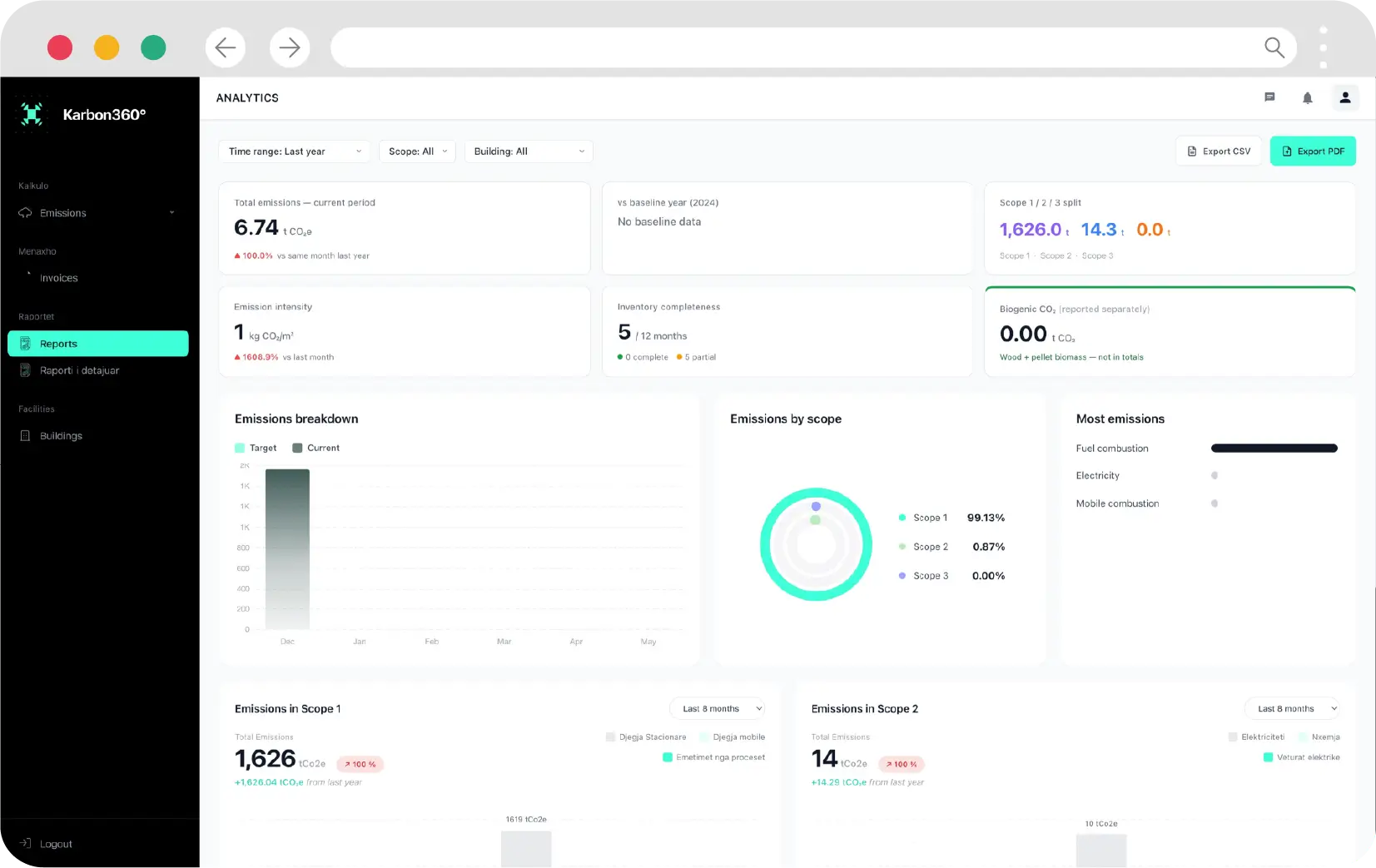
Habitat builds the dataset once: monitoring approach, emissions calculation, completed template, registry entry. Our ClimateTech platform Karbon360° keeps the underlying activity data structured, so next year's request is an update, not a restart.
Karbon360°
Karbon360° transforms energy and production data into structured greenhouse-gas figures — one source of truth behind every CBAM answer you send.
Habitat prepares the whole response.
One engagement, from the forwarded email to a buyer-ready data pack.
Every engagement starts with the request you received. Send it over and you will have scope, timeline and price in writing — a fixed-fee quote within 48 hours.
CBAM for exporters, answered.
How do I respond to a CBAM data request from an EU customer?
Is there a CBAM supplier emissions data template?
Do non-EU operators have to register in the CBAM Registry?
What happens if we do not send CBAM emissions data?
Which products does CBAM cover in 2026?
Does the 50-tonne exemption mean small shipments need no data?
Answer the request before the next one arrives.
Forward us the CBAM data request you received. Habitat scopes the installations, runs the numbers and returns a buyer-ready pack — with scope, timeline and price in writing within 48 hours.