SB 253 scope 3 reporting starts in 2027.
California's SB 253 — the Climate Corporate Data Accountability Act, as amended by SB 219 — covers US companies doing business in California with total annual revenue over USD 1 billion, public and private alike. The first scope 1 and 2 reports are due 10 November 2026. Scope 3 reporting begins in 2027, covering 2026 emissions. That makes 2026 the data year — and scope 3 the part to start preparing now.
Where SB 253 stands right now.
Three facts anchor every California readiness plan as of late 2026.
The first reports are filed via CARB's Report Intake Platform, most companies on FY2025 data. CARB moved the date from 10 August 2026, and the initial implementing regulation has been in effect since 12 October 2026.
Scope 3 reporting covers 2026 emissions. CARB has signalled a phased approach to scope 3 categories in later rulemaking — the final shape is not yet adopted.
The value-chain emissions you will report in 2027 are being generated now. Waiting for the final rulemaking means reconstructing a full year of supplier data after the fact.
Does SB 253 apply to you?
- Revenue test: total annual revenue over USD 1 billion.
- Nexus test: the company does business in California.
- Form test: public or private — SB 253 applies to both. Staying private does not exempt a company.
- All three true? Then SB 253 applies: scope 1 and 2 reporting first, scope 3 from 2027, and limited assurance over scope 1 and 2 generally required for reports submitted from 2027.
Scope 3 under SB 253: why 2027 arrives early.
Scope 1 and 2 are the contained half of the exercise: fuel burned, vehicles operated, electricity purchased. Scope 3 — defined by the GHG Protocol Corporate Value Chain (Scope 3) Standard — is everything else: all other indirect emissions across the value chain, grouped into 15 categories, from purchased goods and services through business travel to the use and end-of-life of sold products. It is the part of the inventory where the data lives outside your own systems, with suppliers, logistics providers and customers.
CARB has signalled a phased approach to scope 3 categories in later rulemaking, and the final category schedule is not adopted. That is not a reason to wait. The reporting year is 2026: purchase ledgers, supplier records, logistics files and travel data are far easier to collect while the year is running than to reconstruct in mid-2027. A corporate carbon footprint built on the GHG Protocol now gives you a defensible baseline whatever shape the final rules take.
The practical sequence: screen all 15 GHG Protocol categories, rank them for relevance to your business, start with the activity data you already hold and close the gaps with structured supplier requests. Country-specific emission factors — never regional averages — keep the result audit-ready.
SB 253 and SB 261: the date table.
| Date | What is due | Data year |
|---|---|---|
| 10 November 2026 | First SB 253 scope 1 + 2 report, filed via CARB's Report Intake Platform | FY2025 for most companies |
| 2027 | SB 253 scope 3 reporting begins; the category phase-in is still under CARB rulemaking | 2026 emissions |
| From 2027 | Limited assurance generally required over scope 1 and 2 reports | — |
| SB 261 (revenue over USD 500 million) | Biennial climate-related financial risk report; first reports were due 1 January 2026, but enforcement is currently suspended pending appeal — SB 253 was not stayed | — |
Companies whose fiscal year ends between 1 January and 1 February 2026 file FY2026 data in their first scope 1 + 2 report. Confirm current filing guidance with CARB (ww2.arb.ca.gov) before relying on any date.
Start the 2026 inventory now.
Begin with what your systems already hold: energy bills, fuel cards, fleet records, purchase ledgers, travel bookings. A first GHG Protocol inventory across scope 1 and 2 is a contained exercise — and it is exactly what CARB asks for first.
Then extend into scope 3, category by category. Habitat runs the screening, builds the data map and manages supplier outreach; Karbon360° keeps every figure, factor and evidence file in one auditable place — ready for the limited-assurance review that applies to reports submitted from 2027.
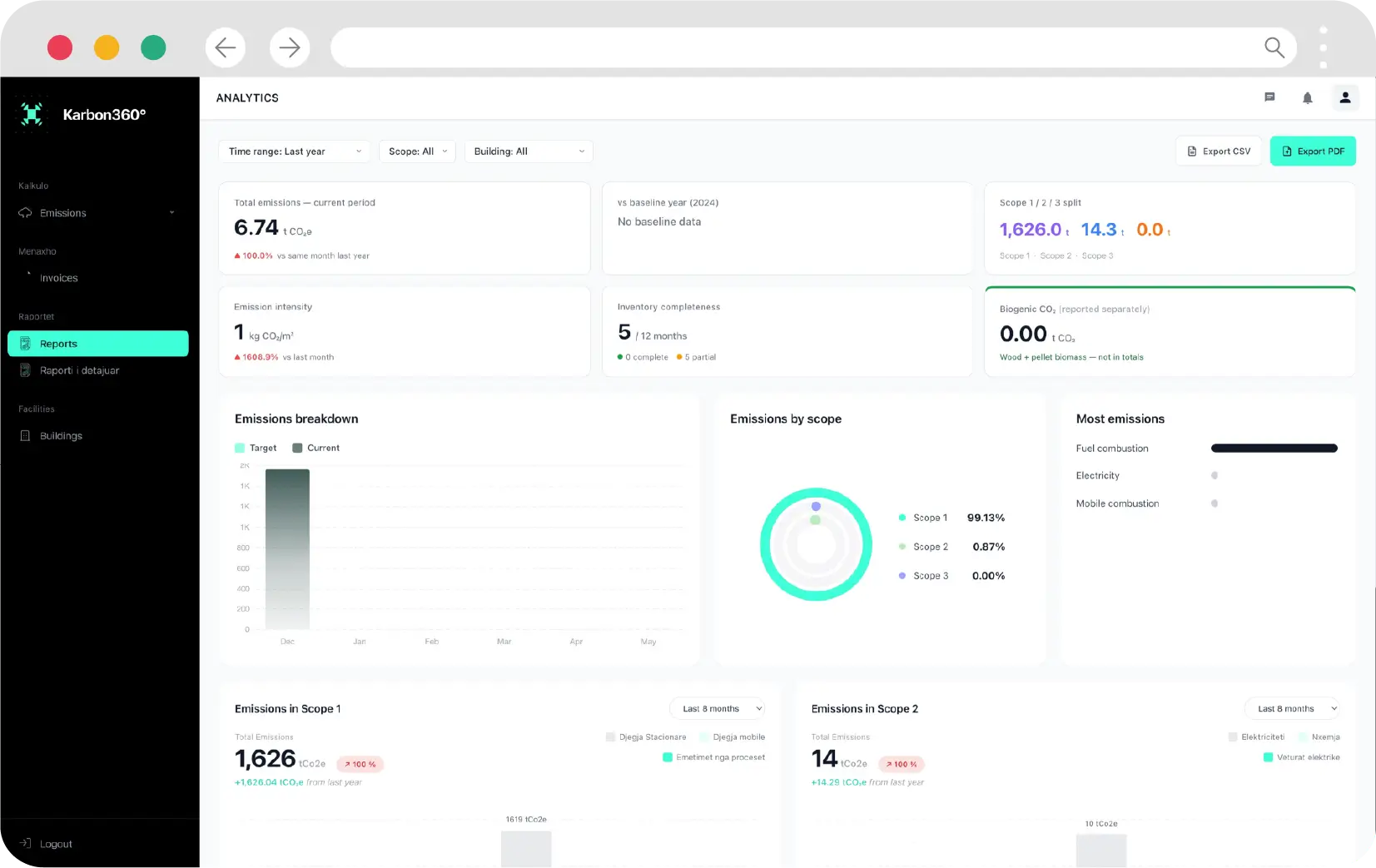
Karbon360°
Karbon360° transforms energy, procurement and business activity data into structured greenhouse-gas inventories across scopes 1, 2 and 3 — built on the GHG Protocol, with country-specific emission factors and a full audit trail.
California climate disclosure consulting, delivered remotely.
Habitat prepares companies for SB 253 end to end — applicability, inventory, scope 3 and assurance readiness — working remotely with your finance, operations and procurement teams.
Every engagement starts with a short scoping call and ends the same week with a fixed-fee quote within 48 hours — scope, timeline and price in writing.
Frequently asked.
Does SB 253 apply to private companies?
When does SB 253 scope 3 reporting start?
What are the SB 253 limited assurance requirements?
What is the difference between SB 253 and SB 261?
Which scope 3 categories have to be reported first under SB 253?
Your 2027 report is built in 2026.
Habitat runs SB 253 readiness end to end — applicability check, scope 3 screening, GHG inventory and assurance-ready documentation, delivered remotely for US companies.