Your first GHG inventory, built to answer the request.
A customer, a procurement platform or a buyer's sustainability team has asked for your emissions numbers — with a format and a deadline attached. Habitat's GHG inventory services build that first number properly: a greenhouse gas inventory to the GHG Protocol Corporate Standard (Scope 1, 2 and 3), delivered remotely and documented so it can be checked, compared and repeated next year.
Where the data request comes from.
Mid-size companies rarely measure emissions because a regulation names them. They measure because a bigger company's regulation turns into their questionnaire — and in 2026 that happens from three directions.
California's SB 253 reaches US companies — public and private — with revenue over USD 1 billion doing business in the state. Their scope 3 reporting begins in 2027, covering 2026 emissions, and purchased goods and services — Scope 3 category 1 under the GHG Protocol — is where supplier numbers land. That category is you.
After Omnibus I, CSRD applies to undertakings with more than 1,000 employees and more than EUR 450 million net turnover, and wave-2 companies report for the first time in 2028 on FY2027. Value-chain coverage means their supplier data collection is running now.
EcoVadis scores companies 0–100 across four themes; CDP grades climate disclosure from A to D−. Both reward emissions that are measured and documented over emissions that are guessed — and both arrive as requests from your largest customers.
Different portals, different formats, one underlying question: what are your Scope 1 and 2 emissions for a defined year, and can you show how you got them. One properly built inventory answers all of it.
From first request to a defensible answer.
A first inventory is a measurement task, not a transformation programme. We scope it that way: four steps, a named deliverable, and scope, timeline and price in writing before work starts.
The deliverable is written for two readers at once: the customer's sustainability team checking your numbers, and your own people, who should be able to answer next year's request without starting over.
What your team needs to gather.
- Electricity invoices for a full reporting year, for every site — the basis of Scope 2, reported both location-based and market-based.
- Fuel records for heating, generators and company vehicles — the core of Scope 1.
- Refrigerant top-ups from maintenance invoices — the Scope 1 source almost everyone forgets.
- Purchased heat, steam or cooling, where any site uses district systems.
- A site and entity list, so organisational boundaries are set before anything is calculated.
- The request itself — questionnaire, portal export or email — so the deliverable lands in the format your customer expects.
Remote delivery, structured data.
The engagement is remote by design. Kick-off and boundary-setting happen on a call, data arrives through a shared checklist, and your invoices and records stay in your own systems. That is how we serve suppliers in the United States and across Europe without a site visit — a first inventory is built from documents, not factory walks.
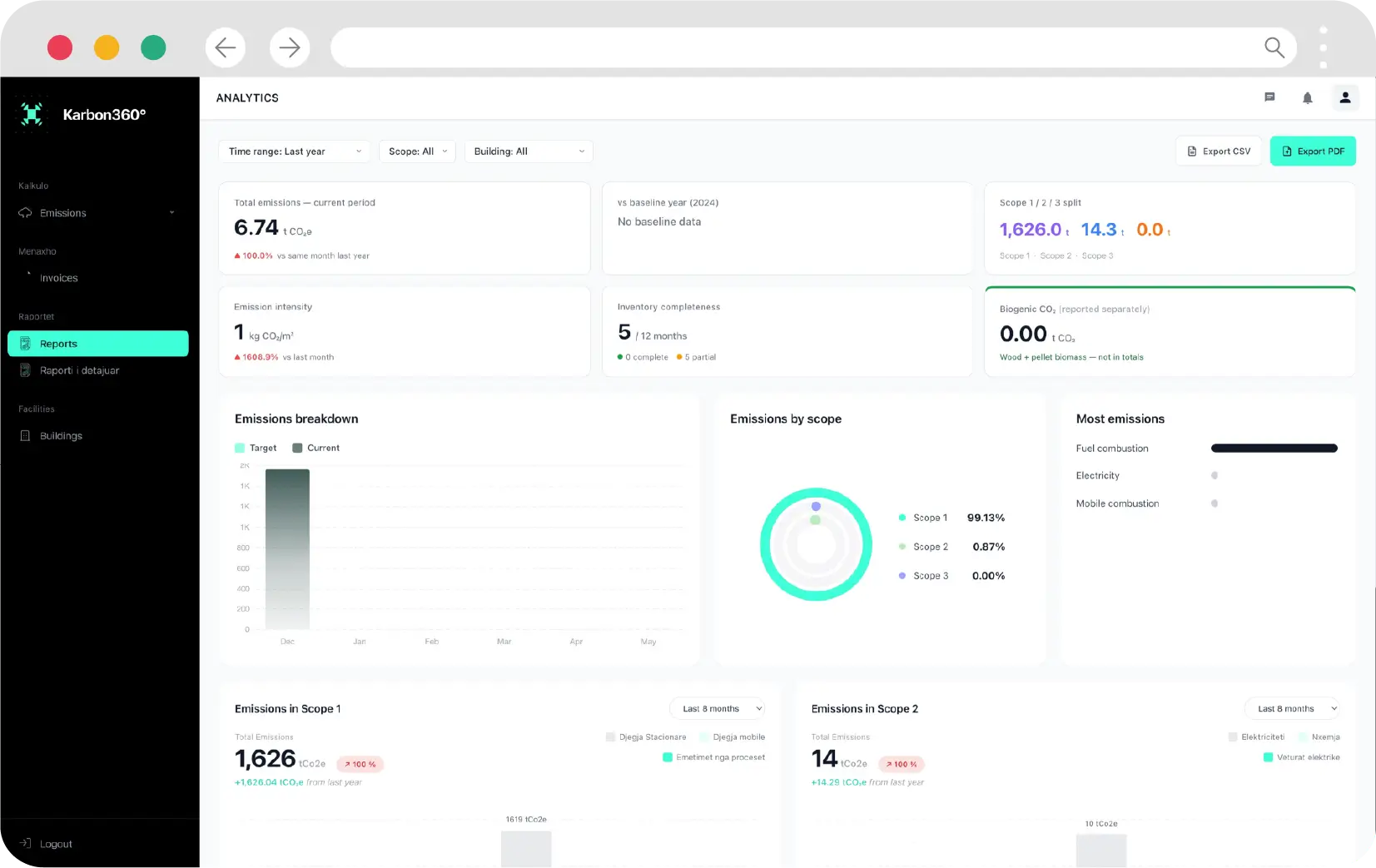
The calculations live in Karbon360°, our own platform: activity data in, scope-by-scope results out, with country-specific emission factors and the evidence trail behind every figure. When the next questionnaire arrives, the inventory is updated — not rebuilt from a spreadsheet nobody remembers.
Karbon360°
Karbon360° transforms energy and business activity data into structured greenhouse-gas inventories — Scope 1, 2 and 3, country-specific emission factors and an evidence trail your customer's team can follow.
Your customer does not want a pledge. They want a number with a method behind it.
A corporate carbon footprint built for suppliers.
In the United States the pressure now runs down the supply chain. SB 253 companies begin scope 3 reporting in 2027, and their purchased goods and services category is populated with supplier data — our guide to SB 253 scope 3 reporting in 2027 explains what that means on your side of the relationship. EcoVadis and CDP requests follow the same logic from the procurement side, and when the goal is a better score rather than a first number, that is its own engagement. Suppliers of steel or aluminium goods bound for the EU face one further, separate exercise: the EU importer is legally required to declare embedded emissions under Regulation (EU) 2023/956, an installation-level calculation we cover under CBAM for US exporters.
What mid-size companies need is rarely a sustainability department. It is a greenhouse gas inventory consultant for mid-size companies — someone who makes the methodology calls, documents them, and leaves behind numbers the finance team can defend on a call with the customer. For EU-facing suppliers the EU has even recommended a ceiling on what may be asked: under the VSME standard (Commission Recommendation (EU) 2025/1710), large companies and banks are asked to limit the sustainability data they demand from SME suppliers to what VSME covers. And when the requests deepen — full Scope 3, assurance, a reduction plan — the same inventory upgrades into our corporate carbon footprint service without starting over.
Frequently asked.
What are GHG inventory services?
Our customer is asking for carbon footprint data — what do they actually need?
Do we need a greenhouse gas inventory consultant, or can we do it in-house?
What is a corporate carbon footprint for suppliers?
How long does a first GHG inventory take?
Can GHG inventory services be delivered remotely?
Answer while it is still a request.
Forward us the data request exactly as you received it. Within 48 hours you get the right scope, a data checklist for your team, and a fixed-fee quote in writing.