CBAM and Kosovo's exporters.
The EU's Carbon Border Adjustment Mechanism has been running in its definitive regime since 1 January 2026. On paper, CBAM touches Kosovo lightly — but for the metal processors and manufacturers feeding EU supply chains, the emissions-data request from an EU customer is now a condition of doing business. Here is what CBAM actually asks of a company in Kosovo — and how to answer it.
What CBAM means for Kosovo.
Five facts set the frame for every Kosovo exporter — and one conclusion.
Since 1 January 2026 CBAM applies for real: authorisation, certificates and annual declarations on the EU side — no longer a reporting exercise.
Cement, iron and steel, aluminium, fertilisers, electricity and hydrogen — plus listed precursors and some downstream products such as screws and bolts.
Your customer, the authorised CBAM declarant, files the declaration and surrenders the certificates. No EU fine reaches a Kosovo producer.
Regulation (EU) 2023/956 defines exactly what your customer must declare — which is why they cannot take silence for an answer.
Importers may fall back on default values — marked up 10% for 2026 imports, 20% for 2027 and 30% from 2028. Verified actual data carries no mark-up.
Clean installation-level numbers are becoming a procurement criterion across EU supply chains. The suppliers who answer well keep selling.
Small on paper, decisive in practice.
On paper, Kosovo is among the least directly exposed economies in the region: CBAM-covered exports to the EU amount to about 1% of GDP on 2021 data. The real exposure sits one step deeper — in metal processing, and in the parts and materials Kosovo firms supply into EU production chains. When the finished product crosses the EU border, somebody in that chain has to produce emissions numbers, and the request travels down the chain quickly.
The regional backdrop makes the direction of travel clear. More than 60% of Western Balkan goods exports go to the EU, which makes this one of the most CBAM-exposed regions in the world — we track the country-by-country picture on our CBAM Western Balkans hub. Brussels is also negotiating a proposed extension of CBAM to further downstream steel and aluminium products from 2028 — not law yet, but pointing one way: more products, more data requests.
Kosovo's specific handicap is the grid. Power generation is almost entirely coal-based, so any emissions figure built from averages comes out heavy. That is exactly why measured, installation-level data matters here more than almost anywhere: it is the only way to show an EU buyer a number that is genuinely yours rather than a conservative default.
Habitat works on this from Prishtina. In October 2026 we signed a Memorandum of Understanding with the Kosovo Chamber of Commerce to accelerate the green transition of Kosovo's business sector — ESG integration, training and climate-technology adoption. Read the announcement.
The CBAM calendar from here on.
| Date | What happens | What it means in Kosovo |
|---|---|---|
| 1 January 2026 | Definitive regime applies — only authorised CBAM declarants may import covered goods above the 50-tonne annual threshold | EU customers now carry a hard legal duty; data requests follow |
| 7 April 2026 | The Commission publishes the Q1 2026 certificate price: EUR 75.36 per tonne | Your buyer can already put a euro figure on your emissions |
| 1 February 2027 | Certificate sales open on the central platform, covering 2026 imports retroactively | The 2026 CBAM cost becomes cash for your buyer |
| 30 September 2027 | First annual CBAM declaration due, covering 2026 imports; certificates surrendered by the same date | Data for everything shipped in 2026 must be final, verifiable and consistent |
Dates under Regulation (EU) 2023/956 as amended by Regulation (EU) 2025/2083; certificate price as published by the European Commission on 7 April 2026.
From first request to a complete answer.
Exactly what to send when the first EU customer email lands is covered field by field in CBAM for exporters.
One dataset that answers every buyer.
Most producers in Kosovo do not need more compliance documents. They need one clean, installation-level emissions dataset that holds up when an EU customer's verifier looks at it — and can be handed to every buyer who asks.
Habitat builds that dataset with you: energy and production data in, structured emissions out, refreshed each import year. On the EU side, certificate sales open on 1 February 2027 and the first annual declaration is due on 30 September 2027 — your customers are budgeting for your emissions now.
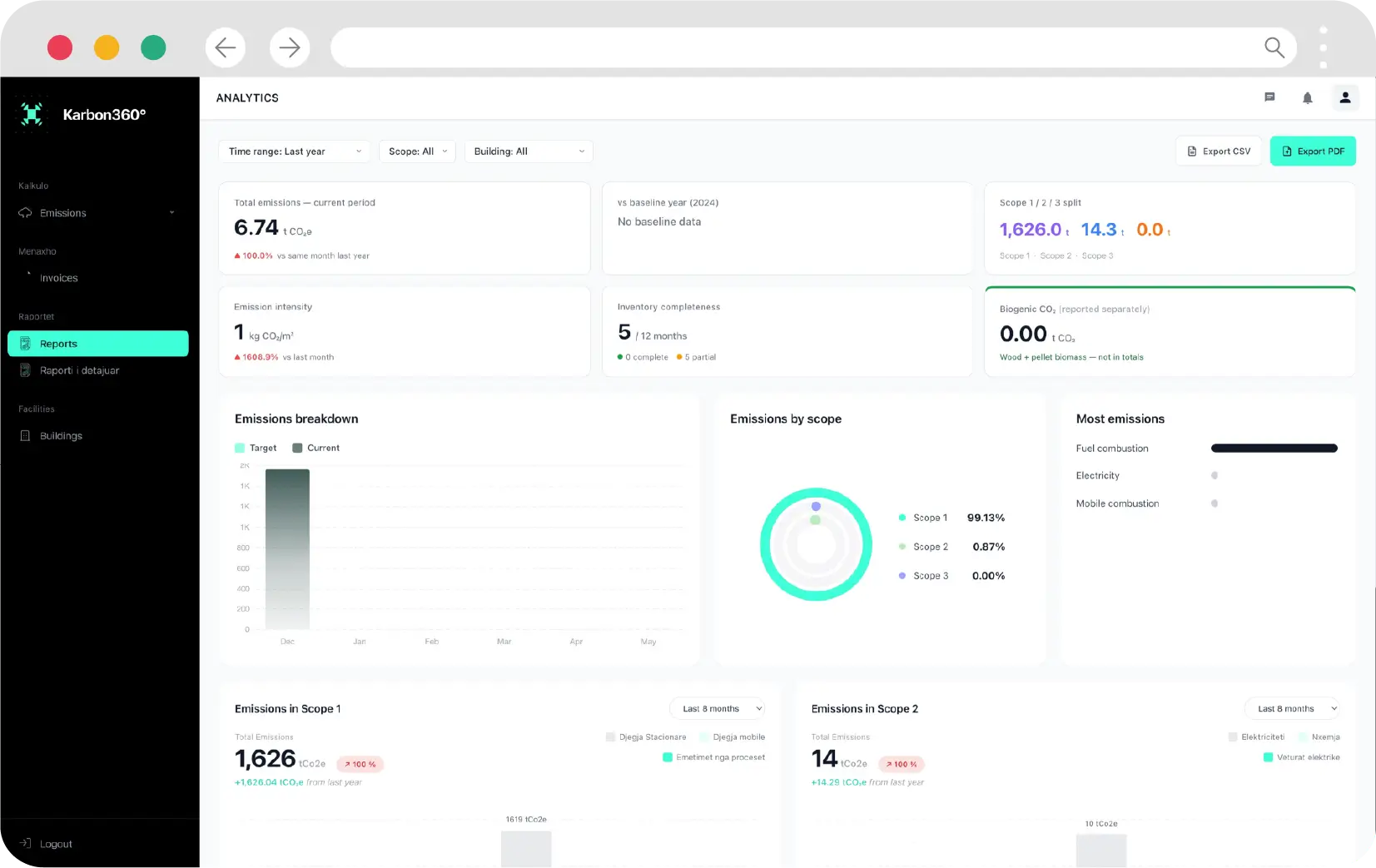
Karbon360°
Karbon360° is Habitat's ClimateTech platform: it turns energy and business activity data into structured greenhouse-gas inventories and CBAM-ready installation data, built on country-specific emission factors — Kosovo's included.
Do not wait for your EU customer to put a number on your emissions. Put your own number on the table first.
Frequently asked.
Does CBAM apply to Kosovo?
Will Kosovo exporters be fined under CBAM?
What data will my EU customer ask for?
Can my customer just use default values instead of our data?
Is there a threshold below which CBAM does not apply?
How do we calculate the carbon footprint of our company in Kosovo?
Answer the next CBAM request with confidence.
Based in Prishtina, working across the region. Tell us what you export and who is asking for data — you will get scope, timeline and price in writing.